
In Singapore’s fast-changing economy, the question on many professionals’ minds is: “How do I stay ahead?”
Well, you live and you learn — so goes the saying, but this time, quite literally: the answer many have arrived at is continuous learning and upskilling. Many working professionals, including those in leadership roles, are seeking additional qualifications as a means to remain competitive, resilient, and future-ready.

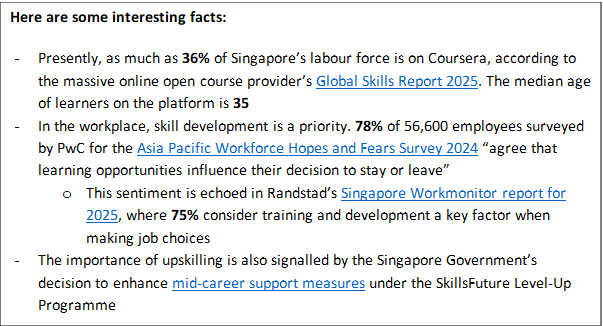
Wait, What’s Driving This Surge?
Gone are the days when professionals stayed in the same workplace for decades till retirement.
Today, the workplace undergoes significant changes at the drop of rapid pace, and a significant force driving this is the rapid advancement of artificial intelligence and digital technologies. Many major company-wide layoffs worldwide have been AI-inducedi, leaving many questioning how long their existing skillsets will remain relevant against technology’s rapid development.

If highly prized skills can quickly become outdated, while new capabilities in areas such as digital strategy are now expected as a baseline, what’s in store? For professionals, these questions have surfaced: How long will my current skill set remain relevant? How long will my role exist? The only way is to keep adapting, which is why continuous learning has become integral to career resilience. And it’s not only those facing disruption who are reflecting this way — even high performers and established leaders are asking tough questions about how to future-proof their careers.
Of course, there are other reasons beyond digital disruption: a postgraduate qualification, for example, opens doors to leadership or more strategic roles, benefiting professionals looking to advance up the corporate ladder. Certain industries, such as psychology, also require further qualifications for you to be able to work in the field.
What Postgraduate Qualifications Can Provide
Why do some professionals look for a full qualification? Aren’t short courses enough?
These have different pros, and here are what set full postgraduate programmes, specifically, apart:
- The chance to build a strong professional network over an extended period
- Opportunities to build up mastery in a subject area or field, instead of isolated skills
- Putting theory into practice through case studies, simulations, capstone projects or research assignments
- The ability to strengthen important soft skills such as communication, leadership or problem-solving through group work
Did you know?
Many global industry leaders hold postgraduate qualifications, such as Sheryl Sandberg (Former COO of Meta) and Tim Cook (current CEO of Apple), who both hold a Master’s in Business Administration.
Considering taking up a Postgraduate Qualification?
For those considering postgraduate studies, financial and time pressures can be serious obstacles. With so many more commitments to handle than in one’s 20s, further education is often put on the back burner.
That’s why support systems and flexible pathways have been developed to help lighten the burden. One such initiative is the Lifelong Education Scheme (LES) offered by James Cook University (JCU).
An initiative by JCU to give back to the community and foster lifelong learning, working professionals can upgrade themselves through part-time studies, opening doors to advanced learning opportunities that align with their career goals.
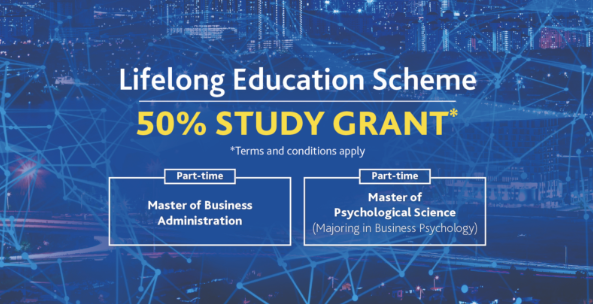
What does the LES offer?
Available year-round (with intakes in January, May, and September) to new part-time students at JCU, the LES provides a 50% study grant for the part-time mode of the following programmes:
- Master of Business Administration (6 different specialisations)
- Analytics and Business Solutions
- Creative Marketing
- Entrepreneurship
- Finance
- Global Talent Management
- MICE, Tourism and Hospitality
- Master of Psychological Science (Majoring in Business Psychology)
The standard part-time mode of Master of Business Administration runs for 16 months, while the Master of Psychological Science (Majoring in Business Psychology) takes at least 32 months*. Students can indicate their interest in JCU and learn more about the scholarship on its page.
If the workplace isn’t standing still, neither can we. If you’ve been thinking about going back to school but remain undecided, consider how a postgraduate qualification does more than buffing your CV. The structure, depth, and networks it provides make it a practical way to prepare for the next stage of work. If you’re mindful about managing your time, part-time options like the above offer the flexibility to manage study alongside work and personal commitments.
Whichever path you choose, here’s wishing you clarity and confidence in your journey ahead!
*Candidates with a relevant Psychology-based degree may be eligible for advanced standing of up to 4 core subjects, which will further reduce the study duration.