Hey, everyone! First of all, Happy New Year! Hope you guys had a good celebration with your friends and family. Have you all done up your New Year’s resolution yet? You know what they say: new year, new you. I spent my New Year travelling. I went to London — it was my first time there — and essentially spent my time enjoying the sights and sounds of the city. I also went on a London West End (i.e. musical theatre) marathon! I watched one play or musical for each day I was there.
But enough about that! Today, I’m here to write about how you can self-learn piano. Now, I love music. It’s a hobby of mine, really. I started learning the piano when I was five, and have been playing it ever since. I even studied music as a subject for my O-level and A-level equivalent, with piano as my main instrument. And I know people out there would like to self-learn a musical instrument (piano included). And so, I thought I would write this guide for anyone looking to learn.
Now, trying to learn a musical instrument by yourself is always difficult and confusing, especially if you don’t have any musical background. It can also be hard to know where to start — many YouTube guides out there advise different things, so knowing where to begin or what exactly to learn as a beginner can be challenging. And trust me, I get it. I’m facing the same problem with electric guitar — when I search online, there are so many things to learn, it’s hard to know where to begin. So, I thought I would write this guide for anyone who is confused but who has an interest in learning piano!
Before we begin, do note that what you should learn depends entirely on what kind of music you are interested in. For example, classical piano differs greatly from jazz or pop. So, I’ll have a section where I discuss common basics and knowledge that you should have, then additional advice for different interests. And with that, let’s get into it!
Common Knowledge: Notes on a Piano
The first thing you should do is to familiarize yourself with the piano or keyboard. You can start by learning the keys (e.g. knowing where the note B is on the piano, for example). Also, when you look at a piano, there are white and black keys. But if you notice, after a while the keys repeat (image below). For the white keys, when you look at C for example, it starts with C and ends with B before repeating.
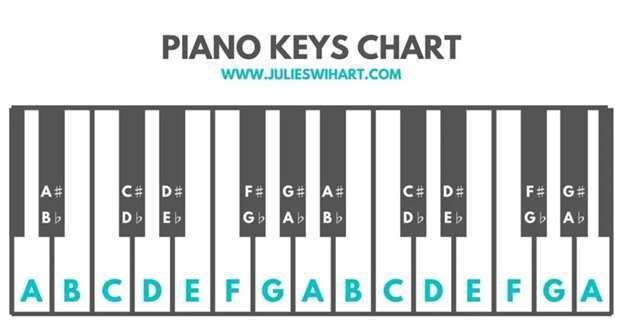
It would be good if you know the notes in general. There is no need to keep practicing memory for these notes; you can move on to other things. Over time, it will become easier to recall where the notes are. But you should at least know what both white and black keys are called.
Common Knowledge: Music Theory
Now, the first thing that everyone should know is music theory. What exactly is music theory? Well, when I say ‘music theory’, I’m talking about the more theoretical aspects that build a foundation for music. Let’s use an example to illustrate this. One very important concept is the idea of a key. No, I don’t mean the key used to open doors. In music, a key determines the structure for an entire piece.
Let’s say we take C as a starting point. We want to write a song or a piece that is in the key of C. Specifically, C major. For C major, specific notes that make up this key: C D E F G A B C. So, when composing music, we usually try to stick to those notes. Random notes like F# or Bb are likely going to sound off. Additionally, certain structures or notes sound better than others. For example, ending a piece with transitioning from the fifth note to the first is often called a perfect ending because it sounds complete. In the case of C major, going from a G to a C will sound like a nice finish.
If you are a complete beginner, you can start by learning the notes in the C major key. After that, you can progress to the notes in each key (from C to B) but only in the major key. Once that is done, you can do it for the minor keys. To do this, one easy but relatively tedious way is to just practice scales. YouTube videos online should cover the notes in a scale. This may be tedious and boring, but it is a very important foundation for music in general, and over time you will be able to identify the chord progression in a piece or song very quickly.
Common Knowledge: Piano Posture
This one may be more difficult to self-learn, but it is a very important part of piano. It is arguably more important for classical pianists, but everyone should have correct hand posture when playing piano, even if it is just chords to a pop song. When you first sit on the piano, try to ensure you are not too far away to the point where your elbows are locked and your arms are outstretched. Also, do not sit so near until your elbows are close to your body. Try and keep a relaxed distance.
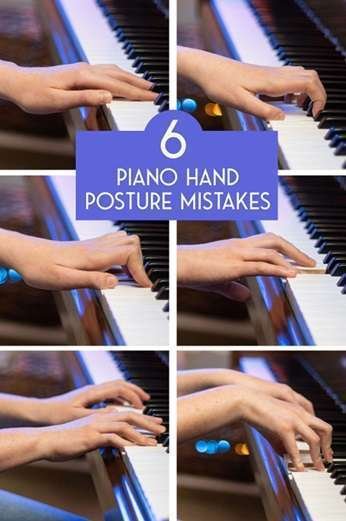
Also, for hand posture, many beginners tend to drop their palms when playing piano, and then attempt to correct it by raising their palm too high (see image below). When playing, imagine you have a tennis ball under your palm. You can even physically put a tennis ball or an egg underneath to try it. Try sustaining that general height when playing. It may feel uncomfortable and weird, but it is very important for playing later on.
Specific Knowledge: Pop Music/Songs
Now, I can move on to specific knowledge. I will start with just general pop music or basic songs. So, this is for anyone interested in playing chords while singing along to any song they like. For this, it is very important to learn chords and inversions. You definitely need to know music theory for this: you need to know what notes go in each key, for both major and minor. You also need to know chords. Technically, chords are just anything that involves two or more notes being played at the same time. But for pop music, the most common is to use triads (i.e. three notes at once).
Every pop song is made out of a certain chord progression. What does this mean? Well, let’s pretend we are in the key of C major. A song may start with C, then move to G, then A minor, then F. In this case, the chord progression is 1 to 5 (G is the fifth note on the C major scale), then 6 (Am is the sixth note), to 4. The song will then likely repeat this loop — so C to G to A minor to F. This is a chord progression. So, you also need to know the basics of music theory, and what chords are being used. For this, you can just Google, but if you don’t know any music theory, then you will spend a very long time figuring out what notes go in each chord.
Once you are comfortable with music theory and using triads, you can change how you play the chords. Adding things like arpeggios or alberti bass can make it sound more interesting and engaging, instead of just pressing the same chord repeatedly for the whole song. You can also learn chord inversions — this will also produce a different sound when played. Although I will not go in-depth into these terms, these are at least some things you can Google, and these are at least some techniques that are more relevant to you.
Specific Knowledge: Jazz/Blues
For jazz or blues, you will have different scales to learn. For example, there are specific scales called the blues scale, and jazz has a lot of different scales such as the Ionian scale. But trust me when I say, learning the original major and minor scales are still useful. These scales simply build upon your understanding of the original scales. But aside from simply knowing the scales, you have to learn which works for which chord, particularly for improvisation.
For these types of music, improvisation is a large part. And so are chords. Jazz and blues tend to use different chords than just the usual major or minor triads. They usually add the 7th note in a chord (search up dominant 7ths) to make it sound jazzier or blues-like. They also have specific chord progressions — for example, the 4-5-1 chord progression is very common in blues. If you want to learn improvisation, you can start with a simple chord progression and practice connecting or transitioning the melody between chord transitions. After all, continuing to play in the key of C major when the chord has moved to A minor is not ideal.
Finally, rhythm is very important. If you want to play pieces related to jazz, or improvisation, the sense of rhythm is usually emphasized. Unlike pop music (which usually is four beats in a bar and often very simple), jazz and blues use a lot of dotted rhythms or triplets, or more unique time signatures. It is very important to get a sense of how to play in time with the music.
One final note: if you wish to learn to play pieces, then learning to read sheet music can also be relevant. It is important, but if you just want to focus on improvisation then it is less necessary. But learning riffs or pieces can help you build on your ideas for improv, and so it is encouraged. You can search up famous jazz or blues composers to see if there are pieces you might be interested in playing.
Specific Knowledge: Classical Music
And now we come to my specialty, classical music. I was classically trained from a young age, and went through the ABRSM examinations. I also played a lot of classical music as part of my performance repertoire when I was studying music. For this type of music, I highly recommend a teacher. I think it helps to have someone tell you how different pieces from different time periods should be played, and to have someone help you interpret how you are supposed to play the piece.
But aside from that, I recommend that you listen to different versions of the same piece to see which interpretation you like. And based on what the performers do, you can either try to copy them or to do your own version of it. You can also take aspects of one performance for one part of the piece, and aspects of another performance for another part. It is up to you. But if you are interested in learning how to make a piece sound more musical, then listening to how others play it is definitely of interest.
If you do insist on trying to self-learn classical music, reading sheet music is important. You need to be able to read it for all the pieces you play. In addition, you have to learn it for both treble clef and bass clef (right hand and left hand). The notes are different for both, so please do learn that first. Also, learning how to use the pedal effectively on a piano is a big thing, especially for pieces in the romantic era. If you are trying to self-learn, you should definitely search up pedalling techniques. It will help you greatly.
Afterwards, the rest is just through practice. Practicing how to coordinate the right hand with the left, practicing how to use your entire arm to push down when playing large chords, practicing how to play the music in the appropriate volume. You can search up techniques for doing this, but the first and foremost thing you need to do (this technically applies to all types of music) is just to practice. Keep practicing, and don’t give up.
And that’s all from me! Hope you guys enjoyed, and I’ll see you next time.